FIFA LED stadium light smart system supplier in Bolivia


Quick Answer: A softball field lighting plan should separate infield and outfield targets, then verify average illuminance, uniformity, glare, spill light and pole safety in a project calculation. Fixture count cannot be selected from wattage alone. Budget must include luminaires, poles, foundations, electrical work, controls, design, installation and commissioning.
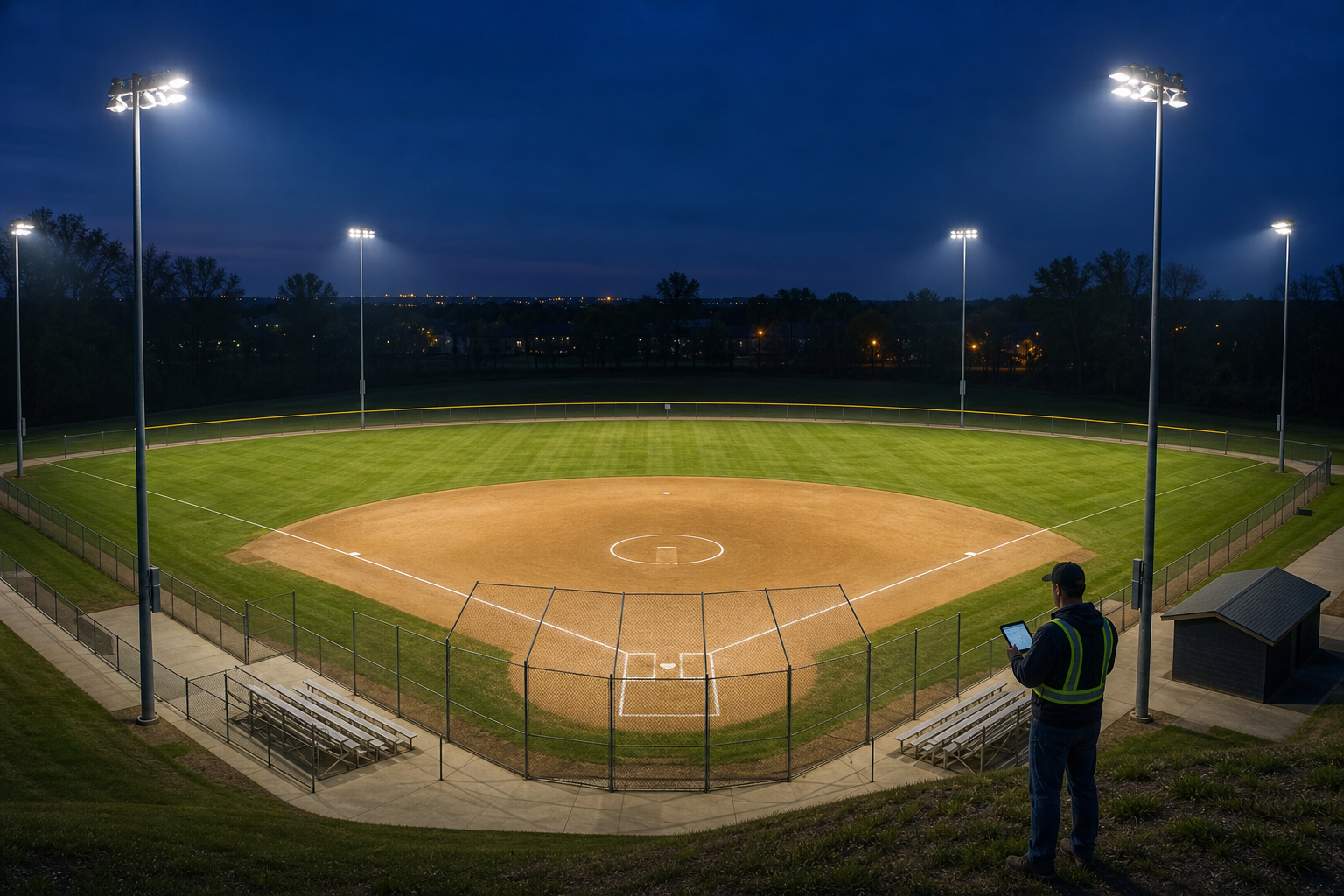
A softball field is visually demanding because the ball is small, fast and frequently viewed against the sky. Players must follow fly balls, ground balls and throws across areas with different surfaces and viewing directions. A bright spot near home plate does not mean the field is well designed. The project must control the transition between the infield and outfield while keeping direct glare out of the players’ main sightlines.
This guide explains how buyers and contractors can define lux targets, compare pole layouts, estimate fixture count and build a realistic softball field lighting cost framework before requesting quotations.
Start with a scaled plan, not a product catalog. Record the backstop, baselines, foul territory, outfield fence, spectator areas, dugouts, nearby roads and property boundaries. Confirm whether existing poles and electrical service will be reused. Field dimensions vary by organization and age group, so the lighting calculation must use the actual site.
The owner should also identify the level of play: recreation, training, competition or broadcast. The approving authority may require horizontal and vertical illuminance, maximum-to-minimum uniformity, glare limits, color quality, flicker performance and spill-light control. These requirements belong in the RFQ before a supplier chooses optics or quantity.
Lux values should come from the governing organization, consultant or local authority. One published reference is the Little League Lighting Standards and Safety Audit. Its competition example specifies 50 footcandles for the infield and 30 footcandles for the outfield, approximately 538 lux and 323 lux. It also specifies maximum-to-minimum uniformity ratios of 2:1 for the infield and 2.5:1 for the outfield.
| Project Type | Target to Put in the RFQ | Important Note |
|---|---|---|
| Recreation or training | Owner- or authority-approved infield and outfield lux targets | Do not assume a universal minimum. |
| Little League competition reference | 50 fc infield / 30 fc outfield, about 538 / 323 lux | Verify the current standard and project eligibility. |
| Higher-level competition | League requirements for horizontal and vertical illuminance | Uniformity, glare and light transition are as important as average lux. |
| Broadcast | Camera-specific vertical illuminance, flicker and color requirements | Obtain criteria from the broadcaster and governing body. |
Footcandles can be converted to lux with the relationship 1 footcandle = 10.764 lux. Always state whether the target is initial or maintained. A maintenance factor should account for lumen depreciation, dirt and operating conditions so the field does not fall below the required level too early.
Average lux alone can hide dark zones. Review minimum illuminance and the maximum-to-minimum or minimum-to-average ratio required by the project. The calculation grid should separately show the infield and outfield, plus the transition near the base paths and shallow outfield.
Glare is especially important behind home plate, along the baselines and when players look upward. Pole position, mounting height, setback, beam angle and aiming all affect discomfort and ball visibility. Spill light should be checked at property lines, nearby homes and roads. Shields can help, but correct optics and aiming should do most of the work.
| Layout | Possible Advantage | Design Risk to Check |
|---|---|---|
| Four poles | Lower civil and electrical scope on some small fields | Longer throws, more fixtures per pole, glare and shadows. |
| Six poles | More aiming positions and better separation of infield/outfield duty | Setbacks, foul-ball zones and nearby property constraints. |
| Eight or more poles | More distribution flexibility for large or demanding venues | Higher structural, wiring and maintenance scope. |
No pole count is automatically correct. Poles must remain outside required safety zones and avoid common player sightlines. A structural engineer should confirm pole, foundation, wind-load and soil requirements. Existing poles require an assessment of condition, height, headframe capacity and projected wind area before LED fixtures are added.
A preliminary lumen calculation can test whether a quotation is plausible:
Estimated fixtures = target lux × illuminated area ÷ (lumens per fixture × coefficient of utilization × maintenance factor)
Example: assume an 8,000 m² calculation area, a screening target of 400 lux, 200,000 initial lumens per fixture, a utilization coefficient of 0.55 and a maintenance factor of 0.80.
8,000 × 400 ÷ (200,000 × 0.55 × 0.80) = 36.4 fixtures
This means approximately 37 fixtures for a rough lumen budget—not a final design. Real quantity changes with separate infield and outfield targets, pole positions, optics, obstruction, aiming, glare limits and spill-light boundaries. Final selection requires photometric files and a point-by-point calculation. Review the broader sports lighting design guide before approving a layout.
The fixture price is only one part of the installed project. Use the following structure when comparing bids:
Luminaires: optics, brackets, drivers, surge protection and controls.
Poles and foundations: engineering, excavation, concrete, reinforcement and headframes.
Electrical: service upgrade, panels, trenching, conduit, cable and grounding.
Controls: contactors, scheduling, dimming, remote monitoring or scene control.
Professional work: survey, lighting design, structural review, permits and inspections.
Installation: lifting equipment, aiming, testing, commissioning and training.
Lifecycle provision: spare drivers/modules, access equipment and planned maintenance.
Compare all bidders on the same scope and Incoterm. A low fixture quotation can become expensive if poles, electrical capacity, brackets, controls, aiming or commissioning are excluded. The stadium lighting cost framework provides a deeper method for normalizing B2B quotations without inventing a universal project price.
Scaled field drawing and playing-area dimensions.
Existing or proposed pole coordinates, setbacks and mounting heights.
Infield/outfield lux, uniformity, glare and spill-light criteria.
Voltage, frequency, controls and operating schedule.
Wind, temperature, corrosion and environmental conditions.
Photos, obstructions, property boundaries and approval requirements.
Buyers can review softball and baseball field LED lights as a product starting point. Wattage and beam angle must then be selected from the project calculation rather than copied from another field.
There is no reliable universal number. Quantity depends on the field area, lux and uniformity targets, luminaire output, optics, pole layout, mounting height and maintenance factor.
The infield often has a higher target because of rapid close-range play. The design must also control the transition so players do not move between abrupt bright and dark zones.
Possibly, but a qualified engineer should review their condition, wind loading, headframe, foundation and the projected area and weight of the new fixtures.
It shows how the exact IES files, pole geometry and aiming produce lux, uniformity, glare and spill-light results across the real field.
No. Useful light on the field depends on lumen output, beam distribution, aiming and geometry. A high-wattage fixture with the wrong optic may waste light or increase glare.
Include drawings, performance targets, pole data, electrical and control requirements, site conditions, destination standards, delivery terms, warranty and commissioning scope.
Send the field drawing, pole information, required lighting level, electrical supply and site conditions. Hishine can review the inputs and prepare a model-specific fixture schedule and lighting proposal.
Author 2024-08-06
LED technology itself is not automatically harmful to children’s eyes. This guide explains the differences between permanent eye damage, temporary visual discomfort and sleep disruption, while showing...
Author 2026-07-29
All-in-one and split solar street lights each offer different advantages. This guide compares their system structure, installation, solar panel flexibility, battery capacity, maintenance, cost, and su...