FIFA LED stadium light smart system supplier in Bolivia


Quick Answer: A reliable LED stadium light manufacturer should be evaluated with model-specific evidence, not a generic catalog or certificate logo. Ask for photometric files, safety and environmental test reports, thermal data, traceable quality records, project design support, warranty procedures, production lead time and spare-part commitments before comparing price.
Choosing a supplier for a stadium or high-mast project is different from buying a standard indoor lamp. Optics, pole geometry, aiming, electrical protection, controls and maintenance all affect the result. A low unit price cannot compensate for missing beam data or an incomplete warranty process.
This 15-point checklist helps EPC contractors, distributors, consultants and project owners compare an LED stadium light manufacturer on evidence that can be reviewed during an RFQ. It also explains which documents should be tied to the quoted model, wattage and optic.
“Manufacturer,” “supplier” and “factory” are often used interchangeably online. Ask who controls the product specification, optical files, quality records, production schedule and corrective action. The bidder should identify the legal entity, factory address and each party’s responsibilities.
FIFA’s Quality Programme emphasizes consistent lighting, uniform distribution and independent testing of floodlight systems. IEC 60598-1 covers general luminaire safety requirements and tests. ISO 9001 supports confidence in a quality-management process, but does not prove that a floodlight achieves a specific beam or lux level. Match every important claim to the exact product and project requirement.
| Check | Evidence to Request |
|---|---|
| 1. Legal identity | Business entity, factory address and the contracting/exporting entity. |
| 2. Product ownership | Who designs, assembles and controls changes to the quoted fixture. |
| 3. Optical files | IES or LDT files for each quoted wattage and beam angle. |
| 4. Photometric report | Model-specific report from a qualified laboratory, with test conditions. |
| 5. Lighting design | DIALux calculation using the real field, poles, aiming and maintenance factor. |
| 6. Thermal validation | Temperature test points, ambient assumptions and driver/LED operating limits. |
| 7. Electrical protection | Driver model, input range, power factor, controls and surge-protection details. |
| 8. Environmental durability | Model-specific IP/IK and corrosion evidence appropriate to the site. |
| 9. Structural data | Fixture weight, projected area, bracket dimensions and aiming limits. |
| 10. Market compliance | Certificates and reports valid for the exact model and destination market. |
| 11. Traceability | Incoming inspection, batch records and serial or date-code method. |
| 12. Production testing | Functional test, aging/burn-in method and final inspection records. |
| 13. Warranty process | Coverage, exclusions, claim evidence, response time and replacement method. |
| 14. Delivery continuity | Realistic lead time, production capacity, critical-component plan and spares. |
| 15. Project evidence | Sample test, pilot installation or references relevant to the application. |
An IES or LDT file must match the exact optic and power offered. Request the tested model, lumen output and test date. Then require a calculation based on the actual dimensions and poles. A useful proposal shows average and minimum illuminance, uniformity, aiming points and the calculation grid—not only a colorful rendering.
Send the supplier a complete design brief: field dimensions, sport level, required lux and uniformity, existing or proposed pole coordinates, mounting height, electrical supply, control requirements and restrictions on spill light. Our stadium lighting design guide explains how these inputs affect the result. Buyers can also review available LED sports lighting systems before preparing the fixture schedule.
High-power luminaires operate outdoors in heat, dust, rain or corrosive air. Ask where temperatures were measured, at what ambient condition, and whether the driver and LEDs remain within rated limits. Compare the test setup with the actual mounting method.
Electrical review should cover the named driver, input voltage and frequency, dimming or control protocol, surge-protection arrangement and grounding. Structural information should include fixture weight, projected wind area, bracket details and permitted aiming range. Pole and foundation calculations belong to the qualified project engineer; a fixture supplier should provide accurate loads and dimensions for that work.
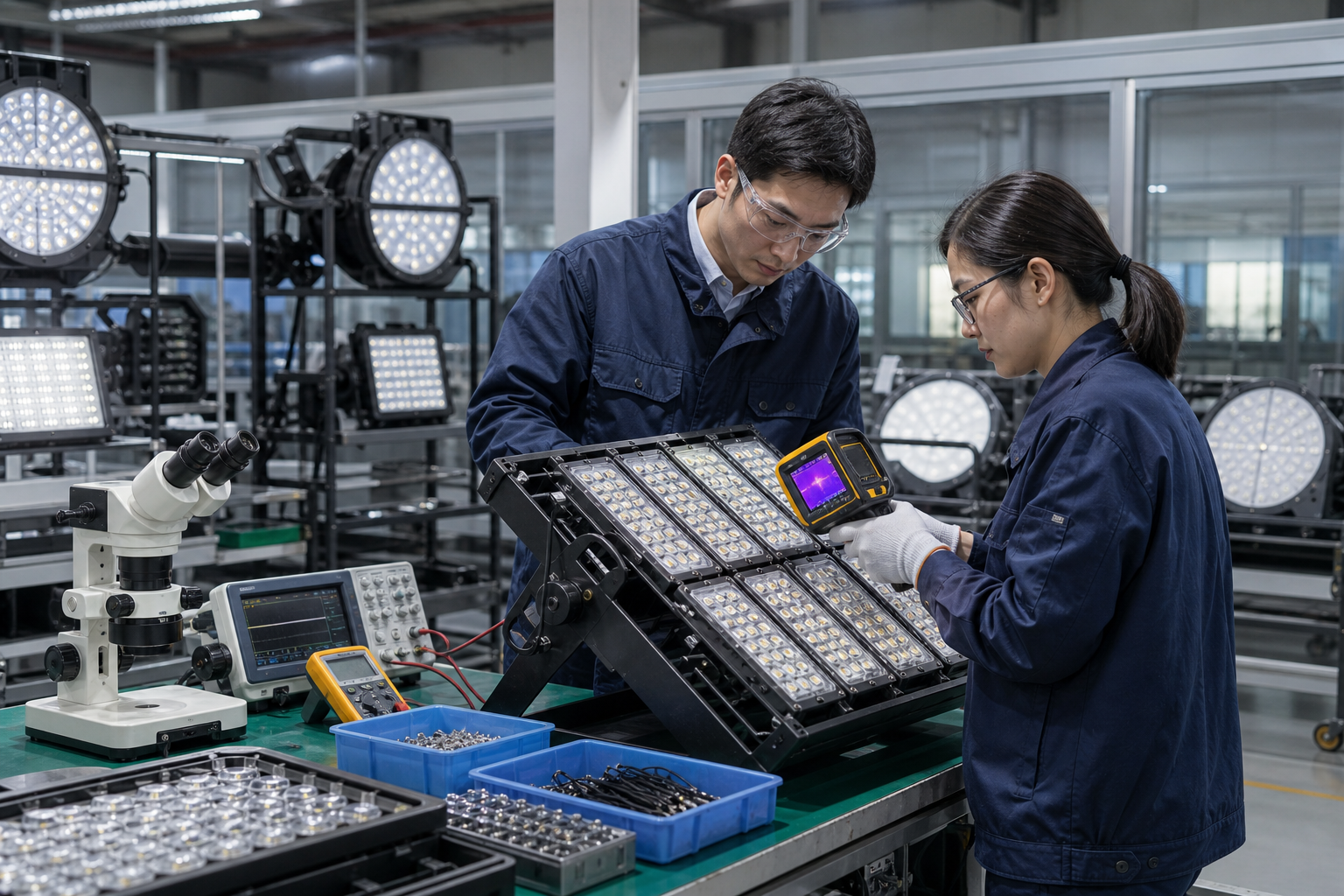
A credible quality plan is observable. Ask how LEDs, drivers, lenses, seals and fasteners are checked; how assemblies are identified by batch; and which tests are recorded before shipment. Define the inspection level and acceptance criteria in the purchase order. Pre-shipment inspection can verify the model, quantity, appearance and operation against the approved specification.
Traceability matters when a field issue appears months later. The supplier should connect a serial number or date code to major components and production records. If private labeling, controls or custom optics are required, review the LED lighting OEM and ODM process and define change-control responsibilities before approving a sample.
Do not accept a cropped certificate image as proof. Request the full document and supporting report. Check the applicant, manufacturer, standard edition, model suffixes, ratings and validity. The RFQ should state the destination market and approval authority.
Also separate three different questions: Is the luminaire safe? Does it produce the documented light distribution? Does the completed installation meet the project’s performance criteria? One certificate rarely answers all three.
Compare quotations on the same scope. Confirm included brackets, surge devices, controls, spares, packaging, freight terms and documentation. Ask for a lead-time breakdown covering approval, sample, production, testing and shipment.
The warranty should define the start date, covered components, environmental exclusions, required evidence, response time and remedy. For installations where access is expensive, agree on spare-part quantities and availability before ordering. The longest headline warranty is not automatically the lowest lifecycle risk.
Field or venue drawings with dimensions and pole coordinates.
Sport level, target lux, uniformity and glare requirements.
Mounting height, power supply, controls and operating schedule.
Site temperature, wind, dust, humidity and corrosion conditions.
Destination market, required documents and approval authority.
Requested delivery date, Incoterm, warranty and spare-parts expectation.
For high-output projects, include a candidate fixture such as 1000W LED stadium lights only as a starting point. Final power, quantity, optics and aiming should follow the project calculation.
Start with a model-specific datasheet and IES or LDT file. They establish the exact fixture, wattage and optic that should appear in later calculations, reports and quotations.
No. It relates to the organization’s quality-management system. Product photometry, safety, environmental durability and project performance need their own applicable evidence.
Match the file to the tested model and optic, review the laboratory report and use it in a calculation based on the actual field geometry. Question unexplained differences between the file, datasheet and quotation.
Not before the technical scope is normalized. Compare equivalent optics, accessories, controls, documentation, warranty, spares and delivery terms, then evaluate total project risk.
For a high-value or customized project, a sample or pilot can confirm construction, electrical behavior, controls, mounting and documentation before mass production.
Provide field dimensions, pole locations and heights, performance targets, surface or sport type, spill-light constraints, power and control requirements, and relevant site conditions.
Send your project drawings, target lighting criteria, pole information, destination market and delivery schedule. Hishine can review the requirements and prepare a model-specific lighting proposal and RFQ response.
Author 2024-08-06
LED technology itself is not automatically harmful to children’s eyes. This guide explains the differences between permanent eye damage, temporary visual discomfort and sleep disruption, while showing...
Author 2026-07-29
All-in-one and split solar street lights each offer different advantages. This guide compares their system structure, installation, solar panel flexibility, battery capacity, maintenance, cost, and su...