FIFA LED stadium light smart system supplier in Bolivia


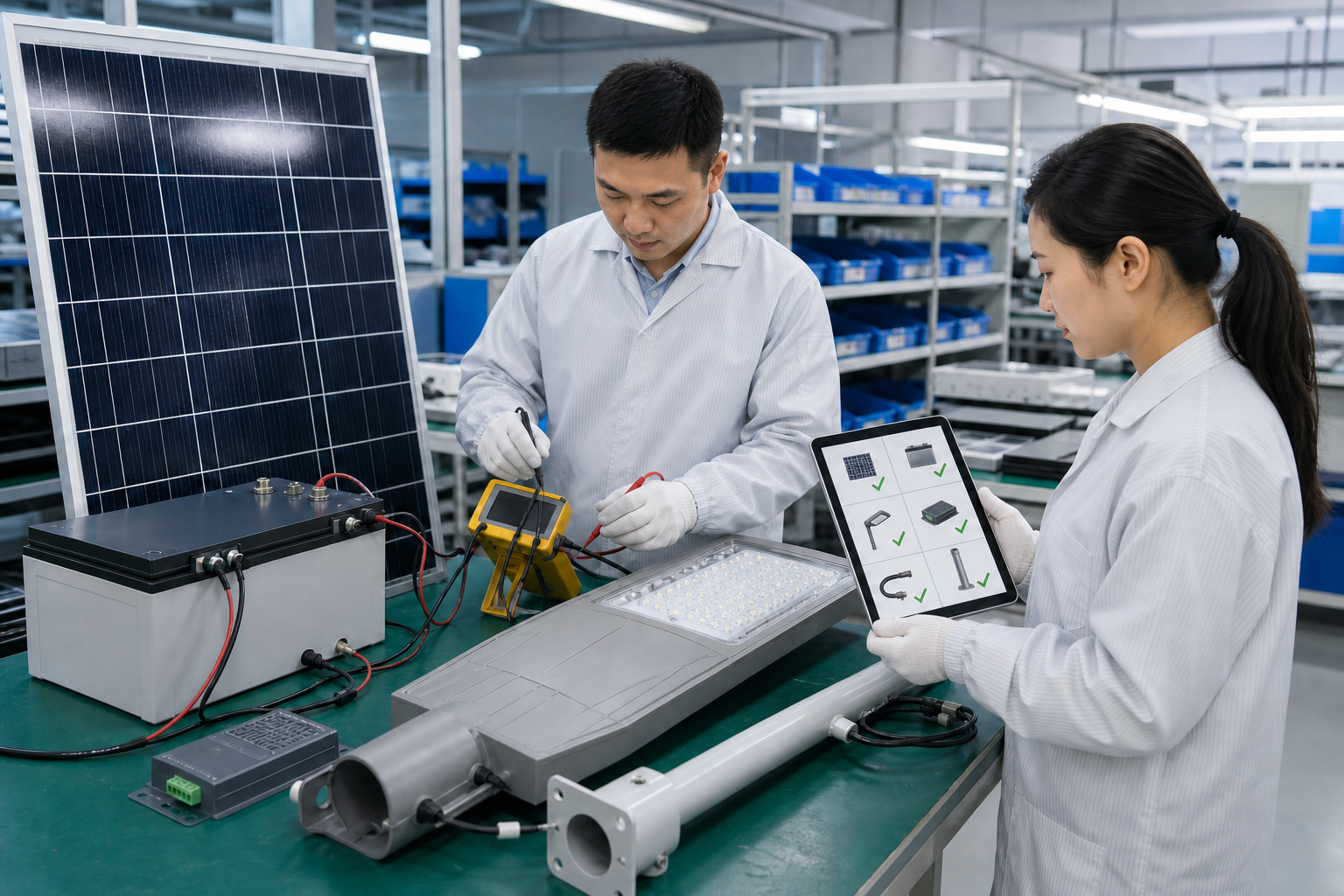
Quick Answer: A reliable solar street light manufacturer should be able to connect every quoted performance claim to a traceable bill of materials, model-specific test evidence, documented quality checkpoints, and a practical warranty process. Before placing a bulk order, buyers should verify the solar panel, battery, controller, LED luminaire, mechanical structure, sample performance, and the exact scope of compliance documents—not just compare wattage and unit price.
For distributors, EPC contractors, municipalities, and lighting brands, supplier selection is a project-risk decision. A low quotation can become expensive if the battery is undersized, the panel specification changes after sampling, or replacement parts cannot be identified. This guide provides a repeatable factory-audit and RFQ method for comparing suppliers on evidence.
A capable supplier should ask for the road width, pole height, pole spacing, operating hours, dimming profile, required autonomy, installation coordinates, seasonal temperature, dust or corrosion exposure, and any target illuminance or uniformity. These inputs influence the energy balance, optics, thermal design, and mechanical configuration.
Begin by reviewing the available solar street light systems, then send one project brief to every shortlisted manufacturer. If suppliers quote different systems from the same brief, require each one to explain its assumptions. This makes technical differences visible before price negotiations begin.
| Buyer input | Why it matters | Supplier output to request |
|---|---|---|
| Road geometry and pole plan | Determines distribution and spacing | Optical proposal or lighting calculation |
| Operating profile | Defines daily energy demand | Hourly power and dimming schedule |
| Location and weather | Affects charging, temperature, dust, and corrosion | Sizing assumptions and environmental options |
| Required autonomy | Sets usable battery reserve | Energy balance and battery basis |
Ask for a controlled bill of materials for the quoted model. It does not need to reveal proprietary purchasing terms, but it should identify component manufacturers, model codes, ratings, approved alternatives, and revision control. Confirm whether the sample and mass-production units will use the same panel, cells, battery pack, controller, LEDs, optics, seals, fasteners, and coatings.
Traceability should link a finished product serial or batch number to incoming component lots, production records, test results, and shipment records. Also ask who approves substitutions. “Equivalent component” is not enough unless the supplier documents the technical comparison and obtains buyer approval.
| Subsystem | Evidence to inspect | Common risk |
|---|---|---|
| Solar panel | Model label, rated power, dimensions, cell layout, supplier data, inspection record | Quoted wattage does not match delivered module |
| Battery pack | Chemistry, nominal voltage and capacity, cell source, BMS, temperature limits, pack test | Nominal capacity is presented as usable energy |
| Controller | Charging method, protections, programmed profile, low-voltage logic, communication option | Default program differs from the project schedule |
| LED luminaire | Power, photometric file, distribution, thermal path, ingress design, surge strategy | Wattage is used as a substitute for lighting performance |
A simple battery check illustrates why definitions matter. A 12.8 V, 100 Ah pack contains 1,280 Wh of nominal energy: 12.8 × 100 = 1,280. Usable energy is lower after allowable depth of discharge, controller and wiring losses, temperature effects, and aging margins. Ask the supplier to show these factors in the project calculation instead of quoting “backup days” without a load profile.
For applications where dust accumulation is a major design issue, buyers can also review the H Series self-cleaning solar street light as one possible system architecture.
Do not accept a certificate folder without checking scope. The document should identify the applicant or manufacturer, tested model, product family, edition, issuing laboratory or certification body, and any critical component list. The applicable requirements depend on the destination market and tender.
As useful reference points, IEC 61215-1:2021 addresses design qualification and type approval for terrestrial photovoltaic modules, IEC 62619:2022 addresses safety requirements for industrial secondary lithium cells and batteries, and IEC 60598-2-3 covers particular requirements for road and street lighting luminaires. These references do not mean that every integrated solar light requires all three certifications. Use the project specification and local authority requirements to determine what is applicable.
A factory tour is useful only when it follows the product flow. Review incoming inspection, battery assembly or incoming pack verification, soldering and connector controls, sealing, torque control, controller programming, functional tests, aging, final inspection, packaging, and nonconformance handling. Ask to see recent blank records and completed examples for the same product family.
Before bulk production, approve a documented sample or pilot lot. Record model numbers, component labels, programmed lighting mode, photographs, key dimensions, weight, optical file revision, and test results. Define which characteristics are frozen and how changes will be communicated. For custom branding, packaging, controls, or mechanical work, review Hishine’s OEM and ODM lighting capabilities.
A warranty statement is only useful when the claim process is clear. Confirm coverage by subsystem, start date, exclusions, required evidence, response time, failure-analysis responsibility, spare-parts policy, replacement logistics, and treatment of discontinued components. Ask whether the battery, controller, panel, LED module, housing, and labor have different terms.
For long projects, request a recommended spare-parts list and component interchangeability plan. Also define how remote troubleshooting data, photographs, controller settings, and returned samples will be used to identify root cause.
| RFQ package item | Requested evidence | Approval point |
|---|---|---|
| Project brief | Road, pole, climate, schedule, autonomy, target lighting | Assumptions confirmed |
| Technical offer | Datasheet, drawings, BOM summary, energy calculation, optics | Configuration comparable |
| Compliance file | Model-specific reports and certificates required by the project | Scope and edition verified |
| Quality plan | Inspection points, sampling rules, records, change control | Hold points agreed |
| Commercial offer | Incoterm, scope, quantity, lead time, tooling, spares, warranty | Total scope aligned |
Send a complete project brief and ask for the sizing assumptions, system configuration, bill-of-materials summary, lighting evidence, quality plan, applicable compliance documents, and warranty process.
The depth should match the risk. A document review and verified sample may be adequate for a small standard order. Large tenders, custom products, or unfamiliar suppliers justify a deeper on-site or independent audit.
Check the pack label and model, cell and BMS documentation, nominal voltage and amp-hour rating, pack test method, weight, traceability, and sample test evidence. Separate nominal energy from usable project energy.
Compare the required lighting result and operating profile, not the printed wattage alone. Normalize the road layout, optics, nightly energy schedule, battery reserve, panel input, accessories, pole scope, and warranty.
That depends on the destination market, tender, product architecture, and authority requirements. Require documents for the exact quoted model and verify the certificate or report scope, edition, applicant, and critical components.
Yes. Identify the approved sample, document its components and settings, define acceptance criteria, and require written approval before any material or configuration substitution.
Planning a distributor, EPC, or municipal solar lighting project?
Send the road layout, pole details, operating schedule, location, autonomy target, quantity, and required documents. Request a Solar Street Light Factory and Sizing Review.
Author 2024-08-06
LED technology itself is not automatically harmful to children’s eyes. This guide explains the differences between permanent eye damage, temporary visual discomfort and sleep disruption, while showing...
Author 2026-07-29
All-in-one and split solar street lights each offer different advantages. This guide compares their system structure, installation, solar panel flexibility, battery capacity, maintenance, cost, and su...