FIFA LED stadium light smart system supplier in Bolivia


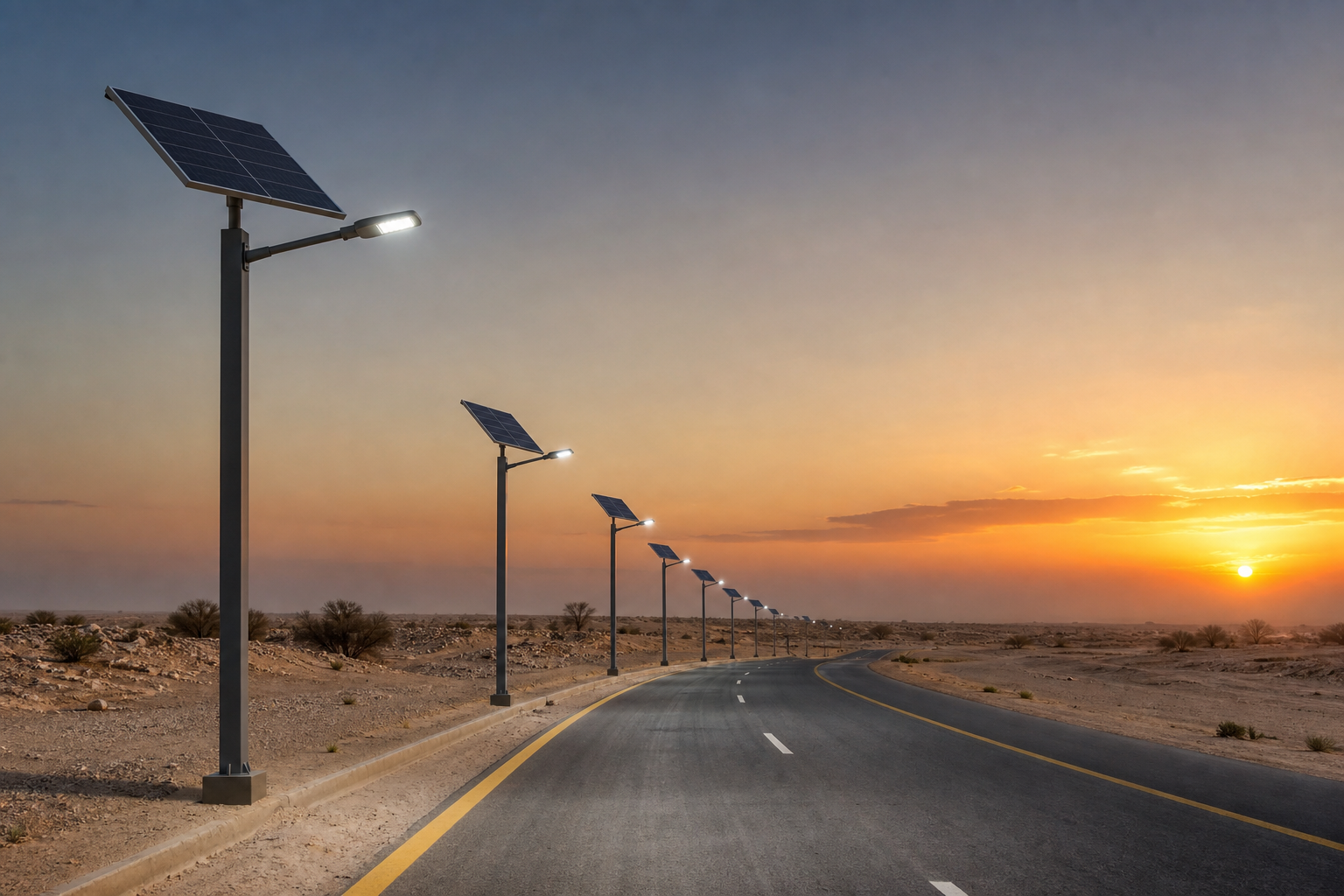
Quick Answer: Solar street lights for Saudi Arabia and the UAE should be configured from the exact location, not a generic “desert model.” Evaluate component temperatures, monthly solar resource, dust, cleaning access, coastal salinity, corrosion, battery limits, wind, and the nightly lighting profile. The supplier should document how every quoted subsystem addresses those conditions.
GCC projects can combine intense solar exposure, dust, long maintenance routes, and—near the coast—humidity and salt. A larger panel alone cannot correct an unsuitable battery enclosure, unverified seals, poor thermal paths, or an inappropriate coating system.
Saudi Arabia and the UAE contain coastal, inland, industrial, mountainous, and open-desert environments. Do not assign one temperature or corrosion category to an entire country. Record the coordinates, coast distance, industrial activity, shading, seasonal temperature and humidity, wind, dust, salinity, flood risk, and maintenance access.
Use location-specific solar data and identify the weakest relevant charging period. State the data source, panel orientation, shading assumptions, and energy-loss factors. For the calculation method, review the rural road solar street light sizing guide.
| Exposure | Evidence to collect | Design decision affected |
|---|---|---|
| High temperature | Seasonal ambient data, solar exposure, enclosure temperature test | Battery, controller, LED and enclosure limits |
| Dust and sand | Event frequency, particle exposure, cleaning interval, sealing evidence | Panel loss, optics, seals and maintenance |
| Coastal salinity | Distance from coast, airborne salt, humidity and wetness | Materials, coating and fasteners |
| Wind and terrain | Local structural criteria, pole geometry, panel area, soil data | Pole, bracket, foundation and orientation |
Ambient temperature is not the temperature inside a sun-exposed enclosure. Identify the limits of the cells, pack, BMS, controller, LED module, seals, wiring, and connectors. Explain enclosure placement, solar shielding, heat transfer, sealing strategy, and temperature-protection logic.
The current IEC 60068-2-2:2025 describes dry-heat environmental tests for both heat-dissipating and non-heat-dissipating specimens. A reference to the standard is not enough: buyers should check the specimen, test temperature, duration, powered or unpowered condition, pass criteria, and whether the tested construction matches the quoted model.
For batteries, request the pack operating window, protection thresholds, temperature-sensor placement, cell traceability, BMS behavior, and capacity basis. Any cycle-life graph should identify its temperature, depth of discharge, charge rate, end-of-life criterion, and tested specimen.
Dust can reduce light transmission through the luminaire lens, decrease solar charging by covering the panel, interfere with moving parts, and enter enclosures through unsuitable joints or pressure paths. Quantify a soiling allowance in the energy model and define how it will be validated or adjusted after commissioning.
IEC 60068-2-68 provides methods for determining the effects of airborne dust and sand on electrotechnical products. It is distinct from an ingress-protection claim. When reviewing evidence, confirm the dust type, concentration or exposure method, duration, specimen operating state, orientation, and acceptance criteria.
Specify panel-cleaning access, inspection frequency, lens cleaning, and how intervals will change after real soiling data becomes available. Where frequent deposition makes manual cleaning expensive, buyers can compare concepts such as the H Series self-cleaning solar street light, while verifying suitability for the exact project.
A dry inland site and a humid coastal site should not receive the same corrosion assumptions. ISO 9223:2012 establishes a system for classifying atmospheric corrosivity and identifies temperature-humidity, sulfur dioxide pollution, and airborne salinity as key factors. Use measured or defensible local inputs rather than treating “UAE” or “Saudi Arabia” as a corrosion category.
Review the pole, brackets, luminaire housing, battery enclosure, fasteners, hinges, latches, connectors, grounding points, and cut edges as one system. Ask for the substrate, surface preparation, coating type, dry-film thickness target, cure control, inspection method, and repair procedure. Check drainage, water traps, crevices, dissimilar-metal contact, and damage that may occur during transport or installation.
| Component | GCC project check | Evidence requested |
|---|---|---|
| Pole and bracket | Wind, panel area, coating, drainage, foundation interface | Drawings, structural inputs, coating specification |
| Battery enclosure | Solar shielding, internal temperature, seals, service access | Thermal test and sealing details |
| PV module | Soiling, temperature derating, mounting, cleaning access | Model data, loss assumptions, bracket drawing |
| Luminaire and optics | Thermal path, dust on lens, glare, maintained output | Photometry, temperature evidence, maintenance factor |
| Fasteners and connectors | Dissimilar metals, salt exposure, UV, replacement access | Material list and assembly controls |
Begin with the approved hourly lighting schedule. Then calculate panel output and usable battery energy with the selected design-month solar resource, component efficiency, wiring and controller losses, temperature effects, dust or soiling allowance, depth-of-discharge limit, aging margin, and required autonomy.
Run sensitivity cases instead of one optimistic result: clean versus expected panel condition, normal versus high temperature, and the intended schedule versus minimum-light mode. State how the battery recovers after consecutive poor-charging days. The objective is a defendable service level, not maximum nameplate wattage.
The exact IES or LDT file, road geometry, pole height, setback, tilt, and spacing must be used in the lighting calculation. Include an appropriate maintenance factor for the environment and cleaning plan. Check glare and spill light near homes, airports, ecological areas, and road intersections according to the responsible authority’s requirements.
Structural design should use the required wind criteria, panel area, pole geometry, bracket loads, foundation and geotechnical data. Do not copy a wind rating from another pole or panel configuration. Maintenance teams must access components without damaging seals or coatings.
| RFQ package | Required supplier response | Buyer approval point |
|---|---|---|
| Site conditions | Location, thermal, dust, salinity, wind and maintenance assumptions | Microclimate is project-specific |
| Energy design | Hourly load, design-month solar data, losses, autonomy and recovery | Assumptions are traceable |
| Environmental evidence | Model-specific heat, dust, sealing and corrosion documentation | Specimen and pass criteria match |
| Engineering files | Photometry, layout, drawings, pole and foundation inputs | Quoted configuration is verified |
| Service plan | Cleaning, inspection, spares, warranty and response process | Lifecycle access is practical |
Buyers should compare complete solar street light systems only after the environmental and road inputs are defined. Use the solar street light manufacturer audit guide to check BOM traceability, sample control, testing scope, and warranty evidence.
No. Requirements vary by project location, authority, road type, coast distance, industrial exposure, temperature, dust, wind, maintenance plan, and lighting criteria.
No. An IP rating addresses defined ingress tests. Buyers should separately evaluate airborne dust and sand exposure, thermal behavior, UV, corrosion, pressure paths, connectors, installation quality, and maintenance.
Use the pack manufacturer’s operating limits and verified data. Check cell temperature rather than ambient temperature alone, BMS protection, enclosure shielding, usable energy, aging assumptions, and service access.
There is no universal percentage. Use local soiling data or a documented preliminary allowance, define the cleaning interval, and validate the assumption during operation.
They require a site-specific corrosion assessment. Airborne salinity, humidity, time of wetness, pollution, materials, coating system, fasteners, drainage, and maintenance must be considered together.
That depends on the current tender, authority, destination market, product architecture, and installation scope. Verify requirements for the exact project instead of accepting a generic certificate list.
Planning a solar street lighting project in Saudi Arabia or the UAE?
Send the coordinates, road drawing, lighting criteria, operating schedule, autonomy target, coastal distance, wind inputs, quantity, and required documents. Request a GCC Solar Street Lighting Review.
Author 2024-08-06
LED technology itself is not automatically harmful to children’s eyes. This guide explains the differences between permanent eye damage, temporary visual discomfort and sleep disruption, while showing...
Author 2026-07-29
All-in-one and split solar street lights each offer different advantages. This guide compares their system structure, installation, solar panel flexibility, battery capacity, maintenance, cost, and su...