FIFA LED stadium light smart system supplier in Bolivia


Quick Answer: A 1500W stadium light is not automatically better than a 1000W unit. The correct choice depends on measured lumens, luminaire efficacy, IES distribution, mounting height, throw distance, glare limits, fixture quantity per pole and total system power. Compare complete photometric proposals—not wattage labels—before approving a sports lighting system.
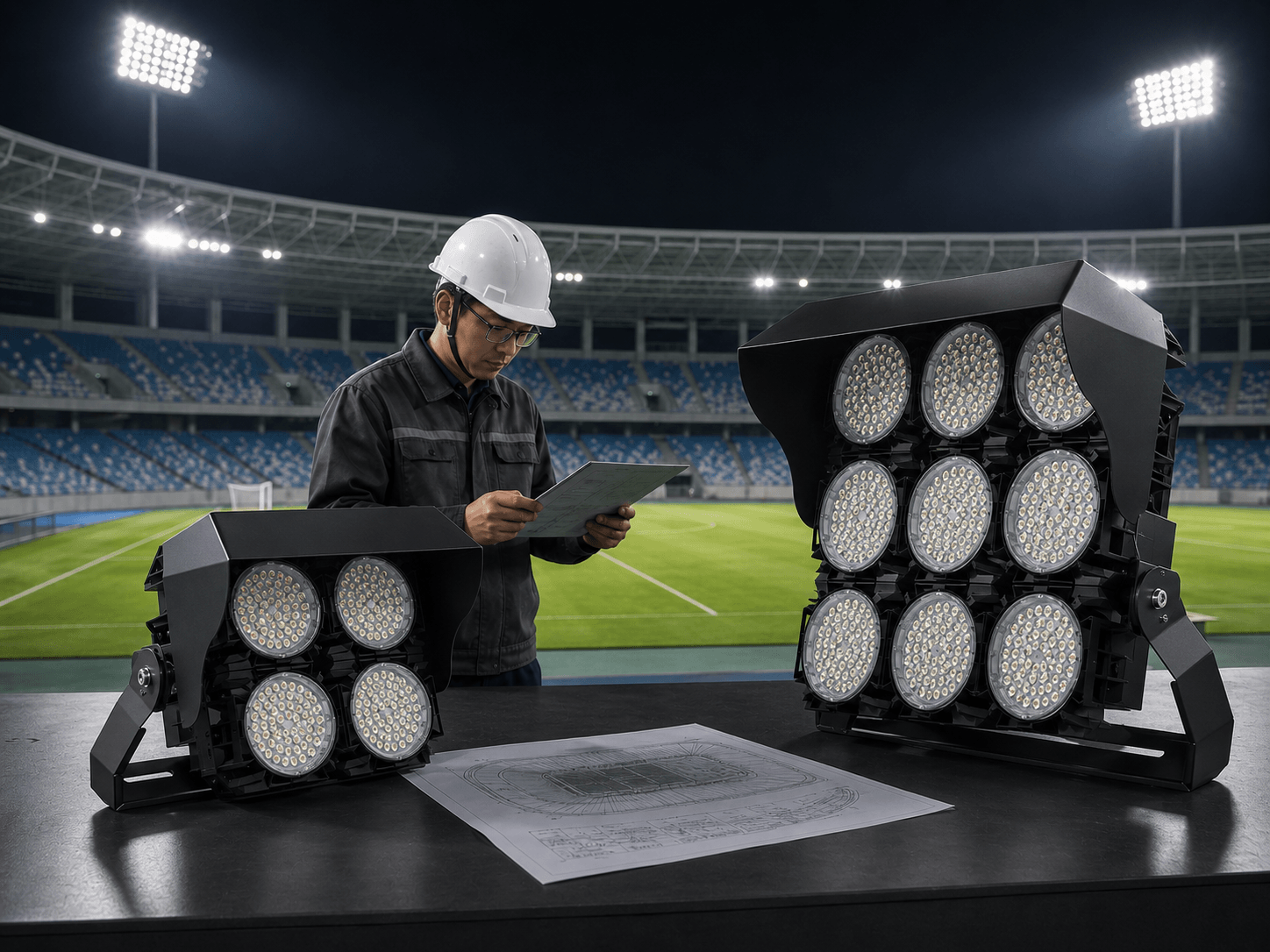
Buyers often ask whether they should specify 1000W or 1500W LED stadium lights. It sounds like a simple power decision, but input watts only describe electrical demand. They do not show how much light reaches the field, where it lands or whether players and neighbors experience unacceptable glare.
This guide provides a B2B comparison framework for stadium owners, contractors and distributors. Hishine's published 1000W LED stadium light is one verified product option. References to 1500W below describe a generic project power class, not a claim that Hishine currently offers a 1500W model.
Two luminaires with the same wattage can produce different useful light because LED packages, drivers, operating temperature and optical losses differ. Start with a laboratory report showing total luminous flux, input power, efficacy and intensity distribution. The current ANSI/IES LM-79 method covers reproducible optical and electrical measurements for solid-state lighting products.
Then examine the IES photometric file. A high lumen value is not enough when an optic sends too much light outside the playing surface or creates a bright hotspot. The useful metric is maintained light on the required calculation grid, achieved with controlled glare and spill.
| Decision Item | 1000W Class | 1500W Class |
|---|---|---|
| Potential advantage | More aiming points and flexibility when several units share a pole. | Fewer luminaires may meet the preliminary lumen requirement. |
| Potential risk | Higher fixture quantity can increase brackets, wiring and aiming time. | Larger steps of light can make glare and uniformity harder to control. |
| Best evaluated by | Model-specific LM-79 data, IES files and the same calculation assumptions. | |
| Not proven by wattage | Illuminance, uniformity, vertical light, glare, spill, reliability or lifecycle cost. | |
A high mast does not always require the highest-wattage luminaire. Mounting height, horizontal throw and aiming angle work together. Long throws may need narrow distributions, while near zones may need wider or asymmetric optics. A successful design often uses a beam mix rather than one beam angle throughout the venue.
Higher poles: can improve aiming geometry and reduce direct glare, but increase structural and maintenance demands.
Longer throws: require sufficient peak intensity and precise aiming, not only more lumens.
Near-field zones: can be overlit by a high-output narrow beam unless the optic and aiming point are changed.
Vertical tasks: ball flight, athletes and cameras may require light from several directions.
Use the LED stadium lighting design guide to define lux, uniformity, pole and glare inputs before comparing power classes.
The correct comparison uses fixture quantity, actual input watts and operating scenes. Consider this hypothetical screening example:
| Option | Illustrative Quantity | Nominal System Power |
|---|---|---|
| A: 1000W class | 24 fixtures | 24 × 1000W = 24kW |
| B: 1500W class | 16 fixtures | 16 × 1500W = 24kW |
Both options show the same nominal system power, but they are not equivalent designs. Option A offers more aiming points. Option B uses fewer luminaires and may reduce some installation items. Either option could win after the IES calculation—or fail because of uniformity, vertical illuminance, glare or pole loading. These quantities are hypothetical and are not a Hishine recommendation.
For annual energy, calculate each control scene:
Annual energy (kWh) = sum of fixture input power × operating hours at each scene ÷ 1,000
Include training, competition, cleaning and security scenes. A system with dimming can use less energy than a simple full-power comparison suggests.
Fewer high-power fixtures do not automatically mean a lighter pole load. Request the exact luminaire weight, effective projected area, bracket drawing and quantity per headframe. A structural engineer should assess the complete assembly for the project wind conditions, pole condition and foundation.
Also verify cable size, branch circuits, inrush current, driver access, surge protection and control compatibility. IEC 60598-1:2024 publishes general safety requirements and tests for luminaires; the RFQ should identify the applicable market standards and request model-specific evidence rather than a generic certificate list.
| System Check | Documents to Request |
|---|---|
| Photometric performance | LM-79 report, model-specific IES file and calculation report. |
| Structure | Weight, projected area, bracket drawing, pole/headframe calculation and wind criteria. |
| Electrical | Input data, driver information, surge protection, wiring diagram and control protocol. |
| Thermal design | Rated ambient range, heat-sink construction and relevant test evidence. |
| Serviceability | Module/driver access, spare-parts policy, warranty process and maintenance instructions. |
A 1000W-class luminaire may be useful when the design needs more aiming positions, mixed beam distributions or incremental control across a headframe. It can also fit projects where the verified pole and electrical system favor the product's weight and input characteristics. The result still depends on the exact IES file and site geometry.
Review Hishine's broader LED sports lighting systems to compare available product families and optics. Do not substitute a product-page maximum wattage for a project calculation.
A 1500W-class option may be considered when long throws and high target levels allow fewer luminaires without sacrificing uniformity, glare control or vertical light. It may reduce fixture count, but each unit also represents a larger portion of the field output. A failure, aiming error or single-step dimming change can therefore have a larger local effect.
Before specifying this class, verify that the actual offered model—not a catalogue family—has the required photometric, thermal, electrical and structural documentation. If the supplier cannot provide a compatible IES file and laboratory report, wattage is not enough to proceed.
Scaled site plan, field orientation, playing area and boundary conditions.
Existing or proposed pole coordinates, mounting heights and headframe details.
Maintained horizontal and vertical illuminance, uniformity, glare and spill limits.
Model numbers, input watts, LM-79 reports and IES photometric files.
DIALux or equivalent calculation using the same grid and maintenance factor.
Fixture quantity per pole, total weight, projected area and structural approval.
Controls, surge protection, supply voltage, operating scenes and annual hours.
Installation, aiming, commissioning, spare parts and warranty responsibilities.
Not necessarily in useful field light. Compare measured lumens, efficacy, optical distribution and the calculated result on the playing surface.
There is no universal replacement ratio. Two fixtures provide two aiming points, while one fixture has one distribution and position. A model-specific calculation is required.
Glare depends on luminaire intensity, aiming, mounting height, shielding and observer position. Wattage alone cannot predict it.
It may reduce brackets, wiring and aiming work, but larger luminaires, structural upgrades, optics, controls and maintenance access can offset those savings.
Use the same field geometry, calculation grid, targets, maintenance factor, pole positions, mounting heights, boundary limits and operating scenes.
Send a scaled drawing, target lighting criteria, pole details, electrical supply, site photos, boundary constraints and any preferred control requirements.
Hishine can compare available luminaire power and beam options against your pole layout and performance criteria. The recommendation should be based on a model-specific photometric plan, not a wattage assumption.
Author 2024-08-06
LED technology itself is not automatically harmful to children’s eyes. This guide explains the differences between permanent eye damage, temporary visual discomfort and sleep disruption, while showing...
Author 2026-07-29
All-in-one and split solar street lights each offer different advantages. This guide compares their system structure, installation, solar panel flexibility, battery capacity, maintenance, cost, and su...